Managing a veterinary practice means juggling consultations, prescriptions, medication stocks, and administrative follow-ups. When software promises to centralize all of this, the question that arises is simple: does it deliver on its promises daily? GMVET1, developed by Centravet, is used by a growing number of clinics in France. This article is based on what users report concretely, particularly on the features that distinguish this veterinary management software from its competitors.
Veterinary electronic signature with Sign.vet: a truly adopted usage
Have you ever asked a client to sign an informed consent form on paper, then searched for the document in a binder three months later? This is exactly the type of friction that the electronic signature integrated into GMVET1 aims to eliminate.
The tool is called Sign.vet. It allows veterinarians to sign prescriptions, certificates, and attestations, and pet owners to sign informed consents, care contracts, or debt acknowledgments directly after the consultation. No need to switch software or print anything.
This is not a theoretical feature. Centravet reports that 126,300 electronic signatures have been completed via Sign.vet, including 17,100 for the month of July 2026 alone. These numbers show real adoption, not a gimmick added to enhance a sales brochure. Several clinics that share testimonials about GMVET1 emphasize that this dematerialization has reduced the time spent on administrative tasks after each consultation.
For a practice that handles several dozen consultations per day, the cumulative gain becomes significant over a week.
Imaging interoperability and GMVET1: what the MyPACS connection changes (and its limits)
A veterinary software does not operate in isolation. Clinics use imaging equipment (radiography, ultrasound) and need results to be accessible from the patient file, without navigating between multiple applications.
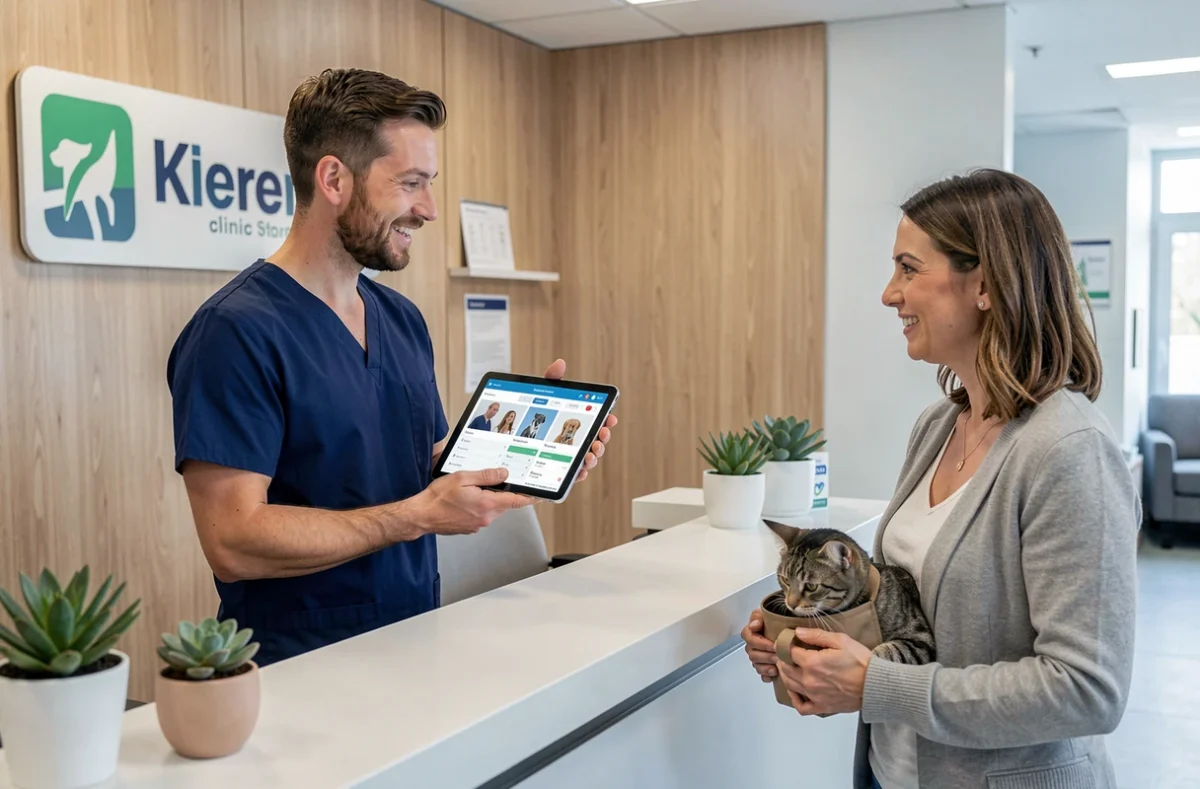
GMVET1 offers an interface with MyPACS, connected via an API key. Specifically, the veterinarian initiates an imaging request from the animal’s file and retrieves the link to the examination without leaving the software. It’s a real gain in fluidity when everything works.
Anticipating friction points
The technical documentation published in 2025 notes dependencies that deserve attention before deployment:
- Network latency can slow down image retrieval, especially in areas where the internet connection is unstable.
- The configuration of the local proxy must be correct for communication between GMVET1 and MyPACS to occur without errors.
- The user rights assigned in the software determine access to examinations: a veterinary assistant may not have the same permissions as a practitioner.
In other words, the integration exists and works, but it does not install in five minutes. A preliminary test with technical support is recommended to avoid unpleasant surprises on the day a client is waiting for their image in the consultation room.
Animal health data and GDPR: a constraint that GMVET1 incorporates into its design
Veterinary records contain data about animals, but also about their owners: names, addresses, sometimes bank details. This information falls under the scope of GDPR.
Why is this point often overlooked? Because many practices consider animal data as “non-sensitive.” Human client data, however, is sensitive. A veterinary software that does not secure this data exposes the practice to sanctions.
GMVET1, as an online hosted solution, must meet data security requirements. The regulatory framework specifically mandates that health data be stored with a certified HDS (Health Data Host) provider when human medical information is involved. For strictly animal data, HDS certification is not required, but GDPR obligations regarding the personal data of owners remain intact.
What this means for a practice
By choosing an online software like GMVET1, the veterinarian delegates part of the technical responsibility for storage. However, they remain responsible for processing the personal data of their clients under GDPR. This involves checking hosting conditions, maintaining a record of processing activities, and informing pet owners about the use of their data.
Online veterinary software: multi-site accessibility and cybersecurity constraints
One of the recurring arguments in favor of GMVET1 is its accessibility from any connected workstation. For a multi-site structure, this means that a practitioner working in two different clinics can access the same patient file without file transfers.
This flexibility has a downside. Each access point is a potential entry point for a cyberattack. Veterinary clinics are not spared from ransomware, and software accessible via a browser requires appropriate protection measures.
- Use two-factor authentication for each user account.
- Regularly update browsers and operating systems on workstations.
- Train staff on phishing attempts, which increasingly target small health structures.
This is not a flaw specific to GMVET1: any online software imposes these precautions. The difference lies in the support offered by the publisher to help practices secure their environment.
Choosing veterinary management software is not just about comparing feature lists. The real adoption of electronic signatures, the quality of integration with imaging tools, GDPR compliance, and robustness against cyber risks are criteria that weigh as much as the ergonomics of the interface. GMVET1 ticks several of these boxes, provided that time is invested in configuration and team training.