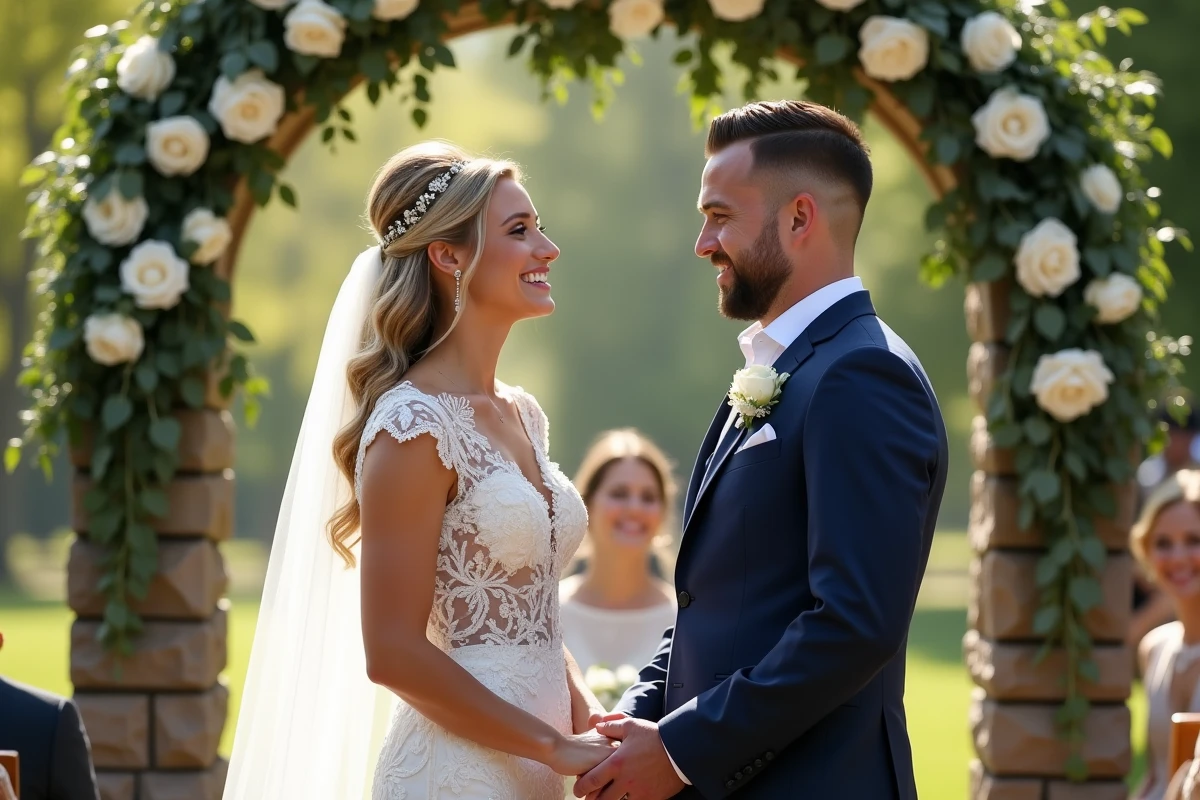
Organizing a wedding generates a mental load that far exceeds the choice of the reception venue or the wedding dress. A significant part of the stress felt by couples comes less from logistics than from interactions with their surroundings: unsolicited opinions, last-minute requests, latent family tensions that resurface as the ceremony approaches. Preparing for a wedding in complete serenity means addressing these friction points as seriously as the budget or the planning.
Boundaries with family and guests: protecting your serenity without creating conflict
Most wedding advice guides focus on decoration, choosing vendors, or logistical checklists. They rarely address the most delicate question: how to set clear boundaries with families when everyone has a say about the menu, the guest list, or the ceremony proceedings.
The problem often starts as soon as the wedding is announced. Relatives express expectations (a distant cousin to invite, a mandated speech, a theme deemed too original), and couples, in an effort not to offend anyone, give in. The result: a wedding that resembles more a family compromise than a celebration that reflects their image.
Setting boundaries does not mean cutting ties. It involves making firm decisions early in the preparations and communicating them clearly. Saying “we’ve decided to limit the guest list to close family and friends” is more effective than a vague “we’ll see.” The earlier the decision is announced, the less it is open to negotiation.
For sensitive topics (seating plan, choice of ceremony, budget allocated by families), designating a single point of contact in each family – a witness, an understanding parent – allows for filtering requests without the couple being in a position of constant arbitration. Feedback from wedding professionals confirms that this approach reduces daily friction during the months of preparation.
Many couples who share their experiences in advance find wedding advice on Univers Mariage useful for structuring their thoughts on these relational topics, beyond just logistics.

Delegating the management of the big day: the most underestimated stress-relief lever
On the wedding day, the couple should not be watching the clock. Planning professionals increasingly emphasize one point: formally delegating the management of the day’s schedule to an identified person, whether it be a wedding planner, a temporary coordinator, or a willing witness.
Delegation only works if it is formalized. A written brief, sent several days before the date, detailing:
- The timings of each step (arrival of vendors, start of the ceremony, opening of the cocktail, start of the meal)
- The contact details of each vendor with the name of the main contact
- The decisions already made regarding common contingencies (a guest’s delay, weather issues, room change)
- The boundaries that the designated person can enforce with the guests (no phones during the ceremony, respect for the timing of speeches)
Without this document, the delegated person improvises and ends up asking the couple for every decision. The brief transforms informal help into true operational coordination.
A moment for two in the schedule: a pause that changes the perception of the big day
Wedding photographers and videographers observe a clear trend: planning a structured moment for two in the schedule of the big day makes a measurable difference in the couple’s experience. It’s not about a vague “we’ll slip away if we can,” but about a time slot clearly written into the schedule.
This moment can take various forms. A first look (mutual discovery before the ceremony) helps ease nerves and experience the emotion privately rather than in front of the assembly. A short walk after the ceremony, while guests enjoy the cocktail, offers a decompression zone.
The challenge is not planning this moment, but protecting it. Guests, families, and sometimes even vendors tend to encroach on this time slot. This is precisely where the day-of coordinator (or the designated witness) plays a filtering role. No one comes to fetch the couple during this break, except in a real emergency.

Wedding budget and vendor choices: deciding rather than endlessly comparing
Constant comparison is the enemy of serenity. Many couples spend weeks requesting additional quotes, consulting online reviews, and hesitating between two venues with similar features. This research phase, useful at first, becomes counterproductive when it drags on.
A concrete method: set the overall budget and the couple’s three priority items (venue, caterer, photographer, or any other trio) from the start. Dedicate research time to these three items, then decide within two weeks after the first meetings. Secondary items (decoration, stationery, entertainment) can be settled more quickly once the pillars are locked in.
Reducing the mental load of preparations
The never-ending checklist found in most guides sometimes creates more anxiety than it resolves. A list of forty tasks to check off over twelve months gives the impression of a titanic project. Grouping decisions by quarter, with a maximum of three to five actions per period, makes the process more manageable.
The other common trap: wanting to personalize everything. A coherent theme applied to a few visible elements (invitations, centerpieces, attire) produces a stronger effect than exhaustive personalization that exhausts the couple and the budget. Choosing three signature elements rather than customizing everything preserves energy for what matters on the day of the reception.
The success of a wedding is not measured by the number of details mastered. It is reflected in the couple’s ability to enjoy the day without having managed every minute, every guest, every unforeseen event. Delegating, setting boundaries early, and protecting a moment of intimacy in the schedule: these three decisions, made in advance, change the very nature of the day.