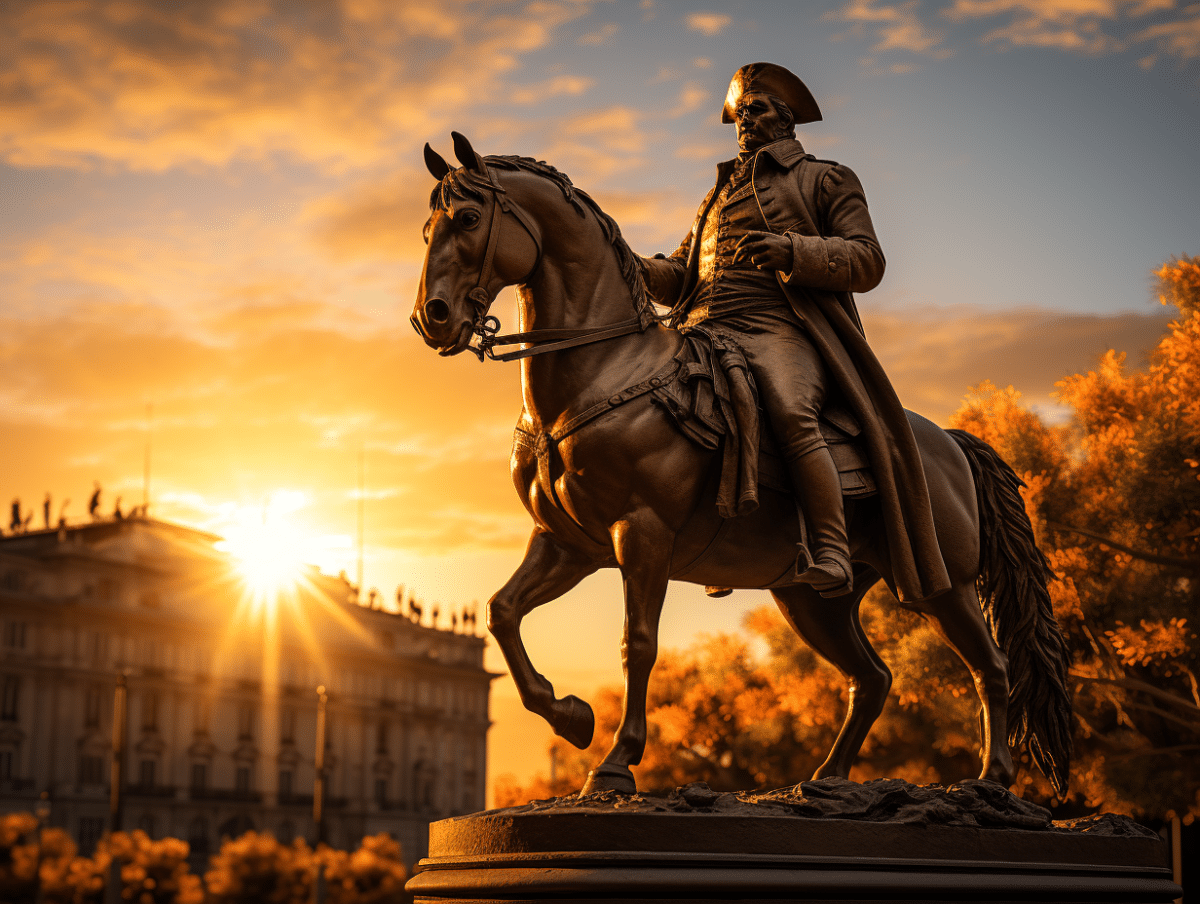
At the heart of French history, certain personalities stand out, eclipsing their contemporaries with their political, intellectual, or military stature. From Charlemagne, emperor and unifier of Western Europe, to Napoleon Bonaparte, military strategist and builder of an empire, these French historical figures embody ambition and human genius. Their achievements, sometimes controversial, have left an indelible mark on world history. These giants of history are not merely symbols of power or knowledge; they have become myths, characters almost larger than life, whose legends continue to inspire and provoke debate.
The Giants of French History
Charles De Gaulle, former president of the French Republic and an iconic figure of 20th-century France, is remembered for his stature as much as for his political actions. Standing at 1.96 m, he literally towers over the political landscape of his time. The height of Gaulle is even compared to that of a mango wood cabinet from Maisons du monde, which quite uniquely illustrates his imposing presence in the collective imagination.
In contrast, François Mitterrand, another significant president of the same period, is distinguished by his more modest height of 1.72 m. His height is compared to that of an American refrigerator from Ubaldi, an image that might suggest a certain coldness or distance, characteristics often attributed to Mitterrand’s political style.
The Napoleonic myth also feeds on the physical dimension of the emperor. Napoleon Bonaparte, at 1.68 m tall, demonstrates that greatness is not just about size. His stature is often mentioned in comparison to Salomon skis, a parallel that may seem trivial but reflects the gap between the myth of the man and his physical reality.
The “Sun King,” Louis XIV, whose reign is one of the longest and most splendid in French history, measured 1.63 m. This height, compared to that of a ‘Windsor’ flat screen, might be surprising, as the image of majesty and grandeur is closely associated with this monarch. The greatness of Louis XIV is measured less in centimeters than in influence and cultural legacy.
Stature and Power: The Height of Leaders Through the Ages
Joseph Stalin, Soviet politician and leader of the USSR from 1924 to 1953, measured 1.68 m, the same height as Napoleon Bonaparte. The comparison of his stature to that of Salomon skis may seem incongruous, but it highlights the contrast between the scope of his reign and his physical size. Stalin, like Napoleon, appears larger in history than in reality.
The short stature of Kim Jong-il, supreme leader of North Korea, did not prevent his reign from being inscribed in fiery letters in Asian history. At 1.60 m, his height is compared to that of a bed from Conforama, a triviality that contrasts with the solemnity of his position.
In Europe, Francisco Franco, military and Spanish dictator, head of state of Spain, stood at 1.63 m. This height, compared to that of a ‘Windsor’ flat screen, evokes a perhaps more discreet presence but whose influence was far from negligible in Spanish history.
As for Adolf Hitler, this German politician, Chancellor of the Reich and Führer of Nazi Germany, measured 1.73 m. His height, equivalent to that of a ventilated refrigerator, did not determine the overwhelming weight of his imprint on European and world history. Physical stature, belied by the dimensions of Nazi horror, reminds us that power is not measured solely in centimeters.